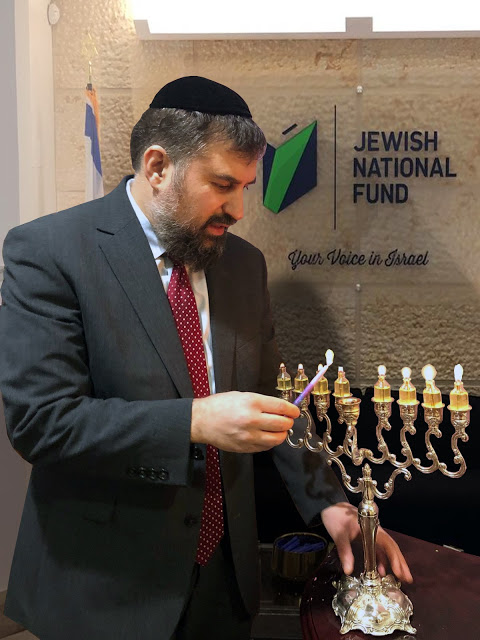
Yossi Kahana lights the menorah.
The History of Chanukah
In the second century BCE, the Holy Land was ruled by the Seleucids (Syrian-Greeks), who tried to force the people of Israel to accept Greek culture and beliefs.
Maccabees and Miracles
Against all odds, a small band of faithful but poorly armed Jews, led by Judah the Maccabee, defeated one of the mightiest armies on earth, drove the Greeks from the land, reclaimed the Holy Temple in Jerusalem, and rededicated it to the service of G‑d.
When they sought to light the Temple's menorah (the seven-branched candelabrum), they found only a single cruse of olive oil. Miraculously, they lit the menorah, and the one-day supply of oil lasted for eight days.
To commemorate and publicize these miracles, the sages instituted the festival of Chanukah.
How is Chanukah Celebrated?
At the heart of the festival is the nightly menorah lighting. The menorah holds nine flames, one of which is the shamash ("attendant"), which is used to kindle the other eight lights. On the first night, we light just one flame. On the second night, an additional flame is lit. By the eighth night of Chanukah, all eight lights are kindled.
Special blessings are recited, often to a traditional melody, before the menorah is lit, and traditional songs are sung afterward.
And Now, we Eat—Oily Foods!
Since the Chanukah miracle involved oil, it is customary to eat foods fried in oil. The Eastern-European classic is the potato latke (pancake) garnished with applesauce or sour cream, and the reigning Israeli favorite is the jelly-filled sufganiya (doughnut).
The Message of Chanukah and the Future of Israel
Happy Chanukah!
Yossi is a director of JNF Task Force on Disabilities.